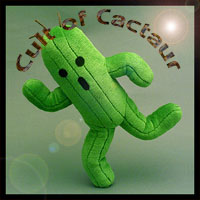
Cult of Cactaur
The team’s identity and calling card. The Cactaur community recognized XenoHammer as having “the most stunning visuals ever seen in a ClanLib powered game.”
A top-down retro modern combat arcade shooter
▶ Play NowFaithfully rewritten in TypeScript from the original C++
Plays in any browser
The Story Behind the Game
XenoHammer is a top-down space combat arcade shooter originally built for PC in late 2001 by four seniors at the Georgia Institute of Technology. Built in just 2.5 months using C++ and the ClanLib game libraries, it features three levels of intense combat, five distinct enemy types, a fully customizable ship, and a climactic multi-part boss battle.
The game was selected as a top 10 finalist in the IGF 2002 Student Showcase and the team was invited to display XenoHammer at a dedicated booth at the Game Developers Conference 2002 in San Jose. Reviewers praised its physics-based explosions, particle effects, and overall graphical polish—remarkable for a student project of its era.
This tribute site preserves the history of XenoHammer and hosts a faithful browser-playable rewrite built in TypeScript and Canvas—made possible through AI-assisted preservation using GitHub Copilot—so a new generation can experience the game as it was meant to be played.
From College Project to GDC and Beyond
Four Georgia Tech seniors build a top-down space shooter in C++ using ClanLib and OpenGL. The alpha of “Codename: XenoHammerGL” goes live on November 20th, featuring hardware-accelerated particles, translucent shield bubbles, and dynamic lighting.
Selected for the Independent Games Festival 2002 Student Showcase, judged by the Seattle chapter of the IGDA.
The team is invited to display XenoHammer at a dedicated booth at the Game Developers Conference. Reviewers praise the physics-based explosions and graphical polish for a student project.
The game lives on in academic references, GDC archives, and the memories of the ClanLib community. The original Tripod site fades but is archived.
Celebrating 25 years since development began, XenoHammer is faithfully rewritten in TypeScript and Canvas. Playable on any device—desktop or mobile, portrait or landscape—this tribute preserves the full history for a new generation.
AI-Assisted Game Preservation
In 2026, lead engine designer Brian Smith spent a weekend with GitHub Copilot and brought XenoHammer back from the dead.
The original C++ source code had survived 25 years—but it couldn’t compile. The game depended on ClanLib 0.5, a game engine library that no longer exists in any usable form. No headers, no binaries, no documentation. The release binaries of XenoHammer itself were also lost to time.
AI changed the equation. GitHub Copilot was able to read the 25-year-old C++ source, infer what the missing ClanLib engine did from context alone, and help port the entire game to TypeScript and HTML5 Canvas. The velocity math, the 8-angle turret lookup tables, the particle systems, the power management—all reverse-engineered from source that referenced a library nobody had anymore.
The result is a faithful browser-playable version that runs on any device, including mobile with full touch controls. Along the way, two features that were planned but never implemented in the original—homing torpedoes and warp drive—were finally brought to life, and several long-standing bugs were fixed. No emulator, no plugins—just a modern rewrite guided by AI that could understand code from another era.
But the preservation didn’t stop there. Copilot also helped build a complete SDL2+OpenGL compatibility shim that reimplements the missing ClanLib 0.5 API—12 header files and ~1,400 lines of implementation—reverse-engineered entirely from how the game code called the library. The original, unmodified C++ source now compiles and runs natively on modern 64-bit Windows as a single portable executable, original bugs and all. Two separate preservation paths: one that brings the game to the web, and one that brings the original code back to life.
~8,000 lines of C++ referencing ClanLib 0.5—a library with no surviving headers, docs, or binaries. The code compiled against Visual C++ 6.0 (1998). Release executables lost. The game was unplayable.
Faithfully rewritten in TypeScript with HTML5 Canvas. All 3 levels, 5 enemy types, boss fights, ship customization, particle effects, and the original soundtrack—playable in any modern browser, on any device.
Tips, Tricks & Enemy Intel
Buy shields as early as possible. They regenerate slowly over time, giving you a crucial safety net during intense waves. Upgrading shields is always a smart investment.
Spending RU’s on research unlocks better weapons and systems. It costs resources upfront, but the payoff in firepower is always worth it in later levels.
The mission briefings aren’t just flavor text. They contain genuine tactical intel about what you’ll face in the next level. Read them before launching.
Standing still is a death sentence. Enemies fire on sight and some will kamikaze straight into you. Keep moving to dodge incoming fire and avoid collisions.
Click Debug in the Options screen to open the debug console. From there you can skip to any level, spawn the boss or frigate, toggle god mode with max power, add resource units, or show the FPS counter.
Hidden in the research tree. Expensive. Worth every RU.
Unlocks the turret angle selector in the Ready Room. Manually set your wing turrets to any of 8 firing directions—forward, diagonal, or broadside. Match your turret angles to the threat. A bargain at just 5 RU.
Your torpedoes gain a mind of their own. Once researched, fired torpedoes lock onto the nearest enemy and track them across the screen. Choose between auto-lock and manual targeting modes. Costs 15 RU.
Upgrades your nose cannon with explosive fragmentation rounds. Every blaster shot that connects detonates into 10 energy fragments that radiate in a full 360° burst, each dealing a fifth of the original damage. Turns single-target shots into area denial. Requires max cannon research. Costs 25 RU.
A reactive shield capacitor that turns defense into offense. When your shields absorb a hit, the Arc Matrix discharges stored energy as chain lightning — arcing between nearby enemies with halving damage per jump. The harder they hit you, the harder you hit back. Requires max shield research. Costs 50 RU.
Quick but fragile. A single well-placed shot takes them down, but they’re fast and fire on sight. They appear in swarms starting from Level 1. Keep moving and pick them off before they overwhelm you.
Equipped with two wing cannons, the Gun Ship hovers near the top of the screen and barrages you from above. When it runs out of ammo or takes enough damage, it will kamikaze straight into you. Stay out from directly underneath.
Appears from Level 2 onward. Three times the armor of a Light Fighter but just as fast. They attack in coordinated groups, so focus fire on one at a time to thin the pack quickly.
A massive Level 2 warship with 6 destructible parts: the body, 2 wings, 2 turrets, and a heavily-armored forward bridge. The turrets track your position and fire periodically. The bridge carries a devastating weapon. You must destroy the body to kill it. Collision is instant death.
The final boss at the end of Level 3. Absolutely massive, with 20 destructible parts. Destroy the outer nodes first to drop its shield generator and disable its homing-missile jamming field. Only then can you damage the core itself. Bring everything you have.
Cult of Cactaur
A group of Georgia Tech seniors who built something remarkable in 2.5 months.
Architected the core game engine—rendering pipeline, game loop, collision detection, and the OpenGL particle system that reviewers praised at GDC.
Designed and built the entire UI system—menus, HUD, briefing screens—plus the GUI artwork and level design that structured the game’s progression.
Created the ship sprites, animations, and enemy AI behaviors. Responsible for the visual identity that made XenoHammer stand out in the IGF showcase.
Implemented the save/load system, integrated the Ogg Vorbis audio pipeline, and designed the sound effects and music integration for the entire game.
Composed the original soundtrack that drives the game’s atmosphere—from the tension of combat to the pulse-pounding boss encounters.
Preserved History & Original Materials
Archived from Tripod/Wayback Machine. Some links and images may not function as originally intended.
The team presented XenoHammer in a dedicated booth at the Game Developers Conference 2002 in San Jose. Mason McCuskey attended and reviewed all ten selected games.
“The physics-based explosions were cool… overall, the quality of the graphics was very high for a student project.”
He noted the team of 3 coders and 1 artist built the game in just 2.5 months. Their post-mortem revealed the short schedule paradoxically helped—it kept the team intensely motivated. Given more time, they said they would have gone fully 3D.
The Independent Games Festival selected XenoHammer for their 2002 Student Showcase at the Game Developers Conference in San Jose. Entries were judged by the Seattle chapter of the IGDA.
Team credited: B. Smith, C. Haire, J. Shelton, R. Norris, M. Andrew
We rebuilt the original unmodified C++ source as a standalone Windows executable. A custom SDL2+OpenGL compatibility layer reimplements the missing ClanLib 0.5 engine API—reverse-engineered entirely from the game’s usage patterns—so the original code runs natively on modern hardware, original bugs and all.
Open Source on GitHub
The complete source code for the TypeScript/Canvas web rewrite, the original C++ game, the SDL2+OpenGL ClanLib compatibility shim, all game assets, this tribute site, and the build tooling for both tracks.
🔗 View on GitHubholophone3d/xenohammer
The team’s identity and calling card. The Cactaur community recognized XenoHammer as having “the most stunning visuals ever seen in a ClanLib powered game.”